A Brief History of Time is one of the most famous books almost everyone owns and not quite everyone finishes and both halves of that reputation are earned. Stephen Hawking tried to explain the deepest questions in physics to readers with no scientific training and the fact that millions bought it says something remarkable about our hunger to understand the universe and about Hawking's gift for making the attempt.
What it's about
Hawking takes on the largest questions there are. Did time have a beginning and will it have an end. Where did the universe come from. What happens inside a black hole. Is there a single unified theory that could explain everything at once. He moves from the ancient view of the heavens through Newton and Einstein to the frontier of modern cosmology, explaining the Big Bang, the expansion of space, the arrow of time and his own groundbreaking work on black holes and Hawking radiation.
Famously, he was told that every equation would halve his sales, so he included essentially one and built the rest from analogies and clear, patient prose. The result compresses genuinely difficult physics into a slim, readable volume. Not every page is easy, some concepts require rereading, but the ambition is thrilling: a serious attempt to hand the ordinary reader the keys to the cosmos.
Why everyone's talking about it
The book was a publishing phenomenon, spending years on bestseller lists and turning a theoretical physicist into a household name and cultural icon. It helped create the modern appetite for popular science and inspired a generation of readers to look up and wonder how it all works.
If you are curious about the universe and willing to think, this is a landmark worth reading, concise and endlessly influential. Newcomers should know it demands more concentration than a typical popular-science book and some cosmology has advanced since 1988, though later editions were updated. Come for the Big Bang and black holes and stay for the sheer audacity of trying to explain the universe to everyone.
The verdict, for now
Read it and do not feel bad about rereading the hard bits. Come for the clearest famous attempt to explain time, space and black holes, stay for the wonder of watching one of the great minds make the cosmos feel almost graspable. It earned its place on all those shelves.
Read it if you loved
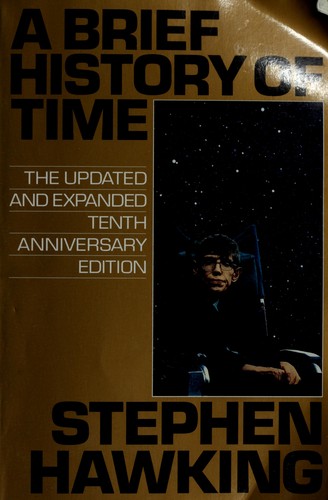
Ready to read A Brief History of Time?
Get it on Amazon →