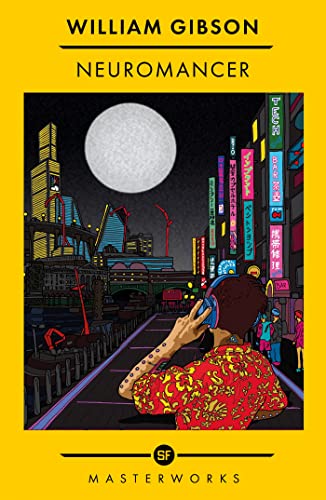
William Gibson wrote Neuromancer on a manual typewriter, by his own account barely acquainted with actual computers, then watched it become the book that named the digital future. Published as a paperback original in 1984, it swept the Hugo, the Nebula and the Philip K. Dick Award, a triple crown no debut had managed before. Four decades on, it remains the novel people reach for when they want to know where cyberpunk began.
What it's about
Case was one of the sharpest console cowboys in the Sprawl until he stole from his employers, who burned out his nervous system as punishment and left him unable to jack into cyberspace. Exiled to the underworld of Chiba City, he is drifting toward self-destruction when a shadowy ex-soldier named Armitage offers a cure in exchange for one job. The offer arrives with Molly, a mercenary with mirrored lenses sealed over her eyes and retractable blades housed beneath her fingernails.
The job itself keeps changing shape. What begins as data theft spirals toward Wintermute, an artificial intelligence tied to the decadent Tessier-Ashpool dynasty, an entity maneuvering against the hard limits placed on machine minds. Gibson tells it as a heist: specialists, insiders, double-crosses. He layers that caper over orbital estates, black-market clinics and a shared virtual reality he calls the matrix, a term later generations would make unavoidable.
Why everyone's talking about it
Neuromancer never really left the conversation; it just keeps finding new on-ramps. Gibson's coinage of cyberspace entered the dictionary, while his aesthetic of neon, rain and corporate feudalism shaped everything from The Matrix to Cyberpunk 2077. An Apple TV+ series adaptation has been in development, sending a fresh wave of readers back to the source. There is also the durable party trick of its prophecy: a 1984 novel that imagined hackers, artificial minds and a networked economy before most households owned a modem.
The verdict, for now
The honest caveat first: Neuromancer is a demanding read. Gibson drops you into his slang without a glossary, the final third gets genuinely murky on a first pass, the characters run cold; Case is easier to follow than to love. Some readers bounce off the prose entirely. But that compressed, noir-lit style is also the point. These sentences still carry a charge most imitators never matched, starting with the famous opener about a sky the color of television. Read it as a mood as much as a story. If it clicks, the rest of the Sprawl trilogy is waiting.
Read it if you loved
Ready to read Neuromancer?
Get it on Amazon →