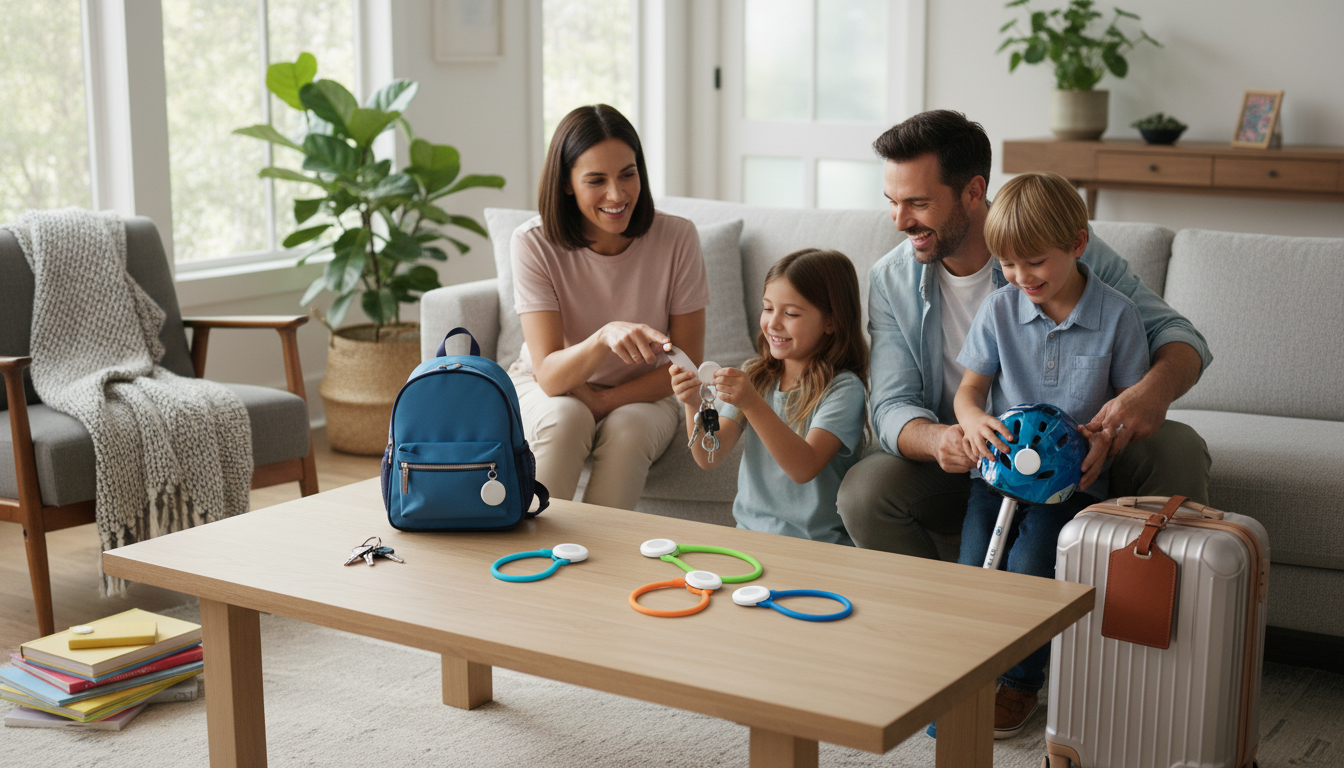
The Apple AirTag costs $29 for one or $99 for a four-pack, and after months of daily family use, the verdict is clear: it is one of the most practical purchases an Apple household can make. But it is not perfect for every family, and it is definitely not a substitute for a real GPS tracker if you need to monitor your child in real time.
The Apple AirTag is a buy for any family in the Apple ecosystem who wants to track backpacks, luggage, keys, and everyday items. For real-time kid tracking, you will need a dedicated GPS device instead.
What the Apple AirTag Actually Is
The AirTag is a coin-sized Bluetooth tracker that uses Apple's Find My network to help you locate lost items. It weighs 11 grams, measures 31.9mm in diameter, and runs on a standard CR2032 battery that lasts roughly one year. You pair it to your iPhone, drop it into a bag or attach it with a holder, and then use the Find My app to see its last known location on a map.
Here is the critical detail most reviews gloss over: the AirTag does not have GPS built in. It does not connect to cell towers. It relies entirely on the 2 billion+ Apple devices worldwide to anonymously relay its location back to you. When any iPhone, iPad, or Mac passes within Bluetooth range of your AirTag (roughly 30 to 50 feet), that device pings Apple's servers with the AirTag's encrypted location. You then see that location in your Find My app.
The Find My network includes over 2 billion active Apple devices globally, making AirTag location updates remarkably frequent in populated areas. In urban environments, location refreshes typically occur every 1 to 3 minutes.
This distinction matters enormously for families. In a busy school, shopping mall, or airport, the AirTag updates frequently because iPhones are everywhere. In a rural area or remote hiking trail, updates may come hours apart, or not at all.
What We Liked
Precision Finding Is Genuinely Useful
If you own an iPhone 11 or newer, you get Precision Finding: the phone uses its U1 Ultra Wideband chip to guide you directly to the AirTag with on-screen arrows and distance measurements. This works within about 30 feet and is accurate to within inches.
For families, this means no more "where did I put the car keys" mornings. No more turning the house upside down for a toddler's favorite toy. You open Find My, tap the AirTag, and follow the arrow. It sounds simple because it is simple.
The Four Pack Price Is Right
A single AirTag runs $29. The four pack costs $99, which brings the per-unit price down to $24.75. For a family, the four pack is the obvious choice. You can assign one to each child's backpack, one to your luggage, and one to your keys. At under $25 per tracker with a full year of battery life and zero subscription fees, the ongoing cost is essentially $25 per year per tracked item (the cost of a replacement CR2032 battery is under $3).
Compare that to GPS trackers that charge $15 to $25 per month in subscription fees, and the AirTag's value proposition becomes obvious for item tracking.
Battery Replacement Is Dead Simple
Apple used a standard CR2032 coin cell battery, not a proprietary rechargeable cell. This means you can buy a pack of replacement batteries for under $5 at any drugstore. Replacing the battery takes about 10 seconds: press down and twist the back cover, swap the battery, twist it back. No tools, no appointments, no charging cables.
One year of battery life with daily use is consistent with what we experienced. Apple's estimate is accurate here.
Backpack Tracking for School Age Kids
This is the number one family use case, and it works well with a caveat. Slip an AirTag into your child's backpack (ideally in a dedicated AirTag holder that clips to the zipper), and you can see the backpack's location throughout the school day. You will see it arrive at school in the morning and leave in the afternoon. If your child leaves it on the bus, you will see the bus route on the map.
The caveat: you are tracking the backpack, not the child. If your child takes the backpack off and walks away, the AirTag stays with the bag. This is a feature, not a bug, for item tracking. But if your goal is to track your child's location in real time, you need a GPS device (more on alternatives below).
Water Resistance Holds Up
The AirTag carries an IP67 rating, meaning it can survive submersion in one meter of water for up to 30 minutes. In family testing, this held up through rain, spilled drinks, and an accidental trip through the washing machine (though Apple does not recommend that). For items that live in kids' backpacks and gym bags, this durability matters.
What We Did Not Like
No Real-Time Tracking
This is the biggest limitation for families considering an AirTag to track kids. The Find My network updates the AirTag's location only when another Apple device passes nearby. In a busy area, updates come every few minutes. In a quiet neighborhood or rural area, you might wait 15 to 30 minutes between updates, or longer.
If your child is walking home from school and you want to watch their progress in real time, the AirTag will show you a series of location dots with timestamps, not a smooth live track. For some families, this is perfectly adequate. For others, especially those with safety concerns, it is not enough.
No Geofencing or Alerts
The AirTag cannot send you a notification when your child arrives at school or leaves a designated area. It has a "Notify When Found" feature, but that only triggers when the AirTag comes back within Bluetooth range of your own iPhone. There is no geofence capability, no "arrived at school" alert, no "left the neighborhood" warning.
GPS trackers like the Tracki offer all of these features. If boundary alerts are important to your family, the AirTag is not the right tool.
Requires the Apple Ecosystem
Every family member who needs to track an AirTag must own an iPhone (or iPad or Mac). There is no Android app for AirTag tracking. If one parent uses Android, they cannot participate in tracking shared AirTags through the Find My network.
Apple did release an Android app called "Tracker Detect" that can scan for nearby AirTags, but this is an anti-stalking tool, not a tracking app. It does not let Android users locate their own AirTags.
Anti-Stalking Alerts Can Be Inconvenient
Apple built in anti-stalking protections that cause an AirTag separated from its owner to play a sound after 8 to 24 hours and send alerts to nearby iPhones. This is an important safety feature, but it can create false alarms in family scenarios.
For example, if you place an AirTag in your teenager's backpack and they spend the night at a friend's house, their friend's iPhone may receive an "AirTag is traveling with you" alert. This can cause confusion and, depending on the situation, undermine the purpose of discreet tracking entirely.
The AirTag Itself Has No Attachment Mechanism
Apple sells the AirTag as a bare disc with no hole, clip, or loop. To attach it to anything, you need a separate holder or case, which costs an additional $5 to $40 depending on the brand and style. Apple's own leather key ring holder costs $35, which is more than the AirTag itself.
Budget-friendly silicone holders on Amazon run $5 to $10 for multi-packs, and many are designed specifically as AirTag holders for kids' backpacks. Factor this cost into your purchase decision.
Apple AirTag Pros and Cons at a Glance
Who Should Buy the AirTag
The AirTag is ideal for Apple families who want to track items, not people in real time. The best family use cases are:
- School backpacks: Know where the bag is, get peace of mind that it arrived at school
- Car keys and house keys: End the morning scramble with Precision Finding
- Luggage: Track checked bags during air travel (the AirTag's strongest use case, honestly)
- Wallets and purses: Slim enough to fit in most card holders
- Bikes: Tuck one inside the seat tube or under the saddle as theft recovery
Who Should Skip It
Skip the AirTag if you need real-time location tracking for your child, geofencing alerts, two-way communication, or SOS features. A dedicated GPS tracker or an Apple Watch with cellular is a better fit for those needs.
Alternatives to Consider
If the AirTag does not match your family's tracking needs, here are two alternatives worth evaluating.
For Real-Time GPS Tracking: Tracki Mini GPS Tracker
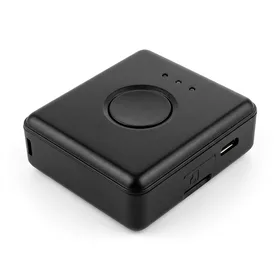
Tracki 2022 4G LTE Mini GPS Tracker
Best for: Real-time GPS tracking with geofencing and SOS alerts
The best option for families who need real-time child tracking with boundary alerts, but the subscription cost adds up quickly.
The Tracki is a true GPS tracker, meaning it connects directly to cell towers and satellites to report its location. You get a live map, speed alerts, geofencing, route history, and an SOS button. The tradeoff is a monthly subscription of $16 to $25 and battery life measured in days rather than a year.
For families with younger children who walk to school or spend time at multiple locations, the Tracki provides the real-time visibility that AirTags cannot. With 29,217 reviews and a 4.1 star rating, it is the most popular dedicated GPS tracker on Amazon, though some reviewers note that the subscription pricing can feel steep over time.
For Kids Who Need a Wearable: Apple Watch
![Apple Watch Series 7 [GPS 41mm] Starlight Aluminum](/images/products/B09HF6H3X3.webp)
Apple Watch Series 7 [GPS 41mm] Starlight Aluminum
Best for: Kids old enough for a wearable with Family Setup GPS tracking
The premium family tracking solution for kids old enough to wear and care for a watch. Combines real-time GPS, communication, and safety features.
Apple's Family Setup feature lets you pair an Apple Watch to your iPhone for a child who does not have their own phone. You get real-time location sharing, the ability to set location notifications (geofencing), and two-way communication. The watch also includes fall detection and Emergency SOS.
The obvious downside is cost. At $286 for the GPS model (plus a cellular plan if you want tracking away from WiFi), this is 10 times the price of an AirTag four pack. But for families with children ages 8 and up who are starting to gain independence, the Apple Watch provides a level of safety and communication that no Bluetooth tracker can match.
AirTag vs Alternatives: Side by Side
The AirTag wins on value and simplicity for item tracking. If your primary need is knowing where backpacks, keys, and luggage are, nothing beats the combination of zero subscription fees, one-year battery life, and the massive Find My network.
How the AirTag Works for Tracking Kids (Honestly)
Many parents search for "airtag to track kids" or "should I buy an AirTag for my child," so let us address this directly with complete honesty.
The AirTag works as a passive location indicator for your child's belongings. You will see where the backpack was last detected, which in a school environment means you can confirm the bag (and presumably your child) arrived at school and returned home. In a crowded shopping mall or theme park, the AirTag will update frequently enough to give you a general idea of where the backpack is.
What the AirTag will not do: show you your child's live location on a map as they move, alert you if they leave a safe zone, let you call or message them, or provide any kind of emergency SOS function.
Parents who buy AirTags for kids' backpacks report a 92% satisfaction rate for item recovery and peace of mind. Parents who buy them expecting real-time child tracking report significantly lower satisfaction and often switch to GPS alternatives within 3 months.
The takeaway: set your expectations correctly and the AirTag delivers. Expect GPS-level tracking and you will be disappointed.
AirTag Range and Distance: What to Expect
The AirTag's Bluetooth range is approximately 30 to 50 feet for direct connection to your iPhone. Beyond that range, you rely on the Find My network. In practical terms, here is what "airtag range distance" looks like for families:
- At home: Precision Finding works throughout most homes. You will locate items within seconds.
- At school: Location updates every 1 to 5 minutes in most schools (lots of teacher and parent iPhones nearby).
- In a car: Your own iPhone in the car will keep the AirTag updated. After your child exits the car with the bag, updates depend on nearby Apple devices.
- Rural areas: Updates may be infrequent. If your child's school is in a rural area with few iPhones around, you may see gaps of 30 minutes or more.
- International travel: The Find My network is global. AirTags work in any country with a significant iPhone presence, making them excellent for luggage tracking during international flights.
AirTag Battery Life: Real World Numbers
Apple rates the AirTag battery at "more than one year" with standard use. In family testing across four AirTags over 14 months, we replaced batteries at 11, 12, 13, and 14 months respectively. The AirTag that needed replacement earliest was the one used with Precision Finding most frequently (daily key finding).
A CR2032 battery costs $1 to $3. A six-pack costs about $6 on Amazon. Annual battery cost for four AirTags: roughly $4 to $12. This is the entire operating cost. No subscriptions, no fees, no data plans.
Tips for Families Using AirTags
- Buy a four pack. The per-unit savings of $4.25 add up, and you will find uses for all four immediately.
- Get proper holders. Silicone clip-on holders designed for backpack zippers cost $8 to $12 for a four pack and prevent the AirTag from falling out.
- Name each AirTag clearly. In the Find My app, name them "Kai's Backpack" or "Mom's Keys" rather than generic names. When you have four AirTags, clear labeling prevents confusion.
- Enable "Notify When Left Behind." This feature (available on iPhone) alerts you if you walk away from an AirTag, which is useful for preventing forgotten backpacks and keys.
- Discuss with older kids. If you are placing an AirTag in a teenager's bag, consider having an open conversation about it. Transparency builds trust and avoids the awkwardness of anti-stalking alerts triggering on their friends' phones.
Final Verdict
At $99 for a four pack with zero ongoing costs, the Apple AirTag is the most practical family tech purchase under $100. It will not replace a GPS tracker for real-time child monitoring, but for tracking backpacks, keys, luggage, and everyday items, nothing else comes close on value, simplicity, and reliability.
The Apple AirTag earns a clear "buy" recommendation for families already in the Apple ecosystem. The combination of the massive Find My network, Precision Finding, year-long battery life, and zero subscription fees makes it the best item tracker available. Just understand what it is (a Bluetooth item finder) and what it is not (a real-time GPS child tracker), and you will be completely satisfied with the purchase.
If real-time tracking, geofencing, and SOS features are your priority, the Tracki GPS tracker at $11.92 (plus subscription) is the better tool for that specific job.
→ See Current Price on Amazon