Few novels have leaked into everyday language the way George Orwell's final book has. Big Brother, doublethink, thoughtcrime, the memory hole: these are now standard vocabulary for talking about surveillance and propaganda. Published in 1949, written while Orwell was gravely ill on the Scottish island of Jura, 1984 remains the book people reach for whenever politics starts to feel like a rigged language game. It is bleak, blunt, occasionally clumsy as fiction; it is also close to indestructible.
What it's about
Winston Smith works at the Ministry of Truth in Airstrip One, a province of the superstate Oceania, where his job is to rewrite old newspaper records so the past always agrees with whatever the Party currently claims. The state watches everyone through telescreens; the ruling figurehead, Big Brother, may not even exist. Winston commits his first crime by starting a diary, a private act of memory in a world where private memory is treason.
His quiet rebellion deepens when he begins an affair with Julia, a coworker, then accelerates when the pair are drawn toward what they believe is an underground resistance. Orwell is less interested in whether rebellion succeeds than in what a totalitarian state must do to a mind to make rebellion unthinkable. The final third, set largely inside the Ministry of Love, remains one of the most unsparing sequences in twentieth century fiction.
Why everyone's talking about it
The book has never really left the conversation. Sales spiked after the 2013 surveillance revelations, then again in 2017 when "alternative facts" entered the news cycle. Every debate about disinformation, facial recognition or state censorship eventually routes through Orwell's vocabulary. Terms he invented, Newspeak among them, now do real analytical work in journalism and political science. That is a strange afterlife for a novel; few books have supplied so much of the language used to argue about the present.
The verdict, for now
As a novel of ideas, it is close to untouchable. As a novel of people, it is thinner: Julia exists mainly to serve Winston's arc, while the long excerpts from Goldstein's forbidden book stall the momentum badly in the middle section. Orwell was a pamphleteer at heart; his prose argues more than it breathes. None of that dents the book's force. Read it for the machinery of the world, for an ending that refuses consolation, for questions about truth that have not aged a day. If you only ever read one dystopia, this is still the one.
Read it if you loved
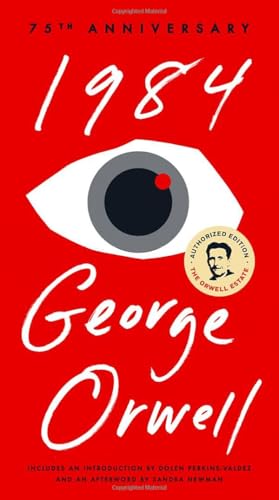
Ready to read 1984?
Get it on Amazon →