Most histories of India end in August 1947, as if the story wrapped up the moment the British left. Ramachandra Guha's "India After Gandhi" begins there instead. Across roughly 900 pages, it argues that the truly improbable story is not how India won independence but how it survived as a single democratic country afterward, against nearly every prediction made at the time.
What it's about
Guha opens with a nation few observers expected to last: hundreds of princely states to absorb, a partition that displaced millions, dozens of major languages, deep religious divides. Western commentators in the 1950s routinely forecast balkanization or military rule. The book traces how India defied them, moving through the integration of the states, the framing of the constitution, the first general elections, the linguistic reorganization of provinces, wars with China and Pakistan, the Emergency of 1975 to 1977, the rise of Hindu nationalism and the economic liberalization of 1991.
What sets it apart is the framing. Guha treats Indian democracy as a genuine historical puzzle rather than an inevitability, giving as much attention to unglamorous machinery like the Election Commission as to towering figures such as Nehru, Patel and Indira Gandhi. Chapters on tribal communities, Kashmir and the Northeast pull in regions that national histories often skim. First published in 2007, the book was revised and expanded for its tenth anniversary to carry the story further into the 2010s.
Why everyone's talking about it
The book has become the standard one-volume account of independent India; it shows up on university syllabi, civil service reading lists and nearly every "understand India" recommendation thread. As debates over Indian democracy, secularism and majoritarian politics have intensified, readers keep returning to Guha's central question of how a poor, divided country sustained universal suffrage from day one. Guha himself has remained a prominent public intellectual, which keeps the book circulating in every new argument about what India was designed to be.
The verdict, for now
This is a serious, deeply researched book that rewards the commitment it demands; few works make institutional history this readable. It is not without limits. The narrative leans heavily on Delhi, the Congress party and high politics, so economic life and everyday society get thinner treatment. Guha also concedes that the closer the story gets to the present, the more it reads as informed journalism rather than settled history, so the final chapters feel less authoritative than the masterful early ones. Accept the length; it earns its place on the shelf.
Read it if you loved
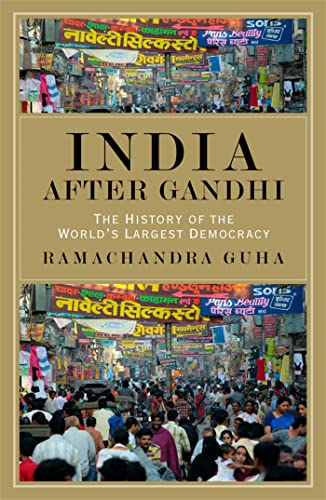
Ready to read India After Gandhi?
Get it on Amazon →