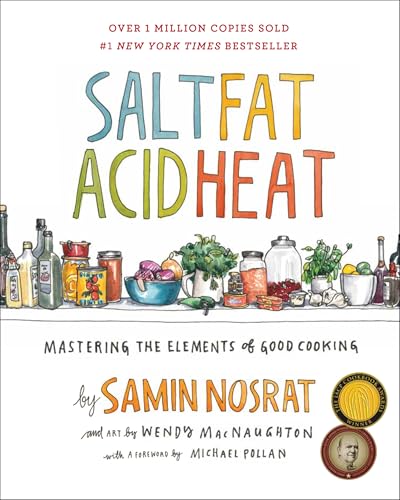
Most cookbooks hand you recipes. Samin Nosrat hands you a compass. Salt, Fat, Acid, Heat argues that good cooking comes down to mastering four elements, not memorizing a thousand dishes. It is the kind of book that changes how you stand at the stove; once you absorb its central idea, you start tasting food differently, seasoning differently, even shopping differently. Few cookbooks published this century have earned that claim.
What it's about
Nosrat, who trained in the kitchen at Berkeley's famed Chez Panisse, organizes the entire craft of cooking around her four title elements. Salt enhances flavor. Fat carries it while creating texture. Acid balances and brightens. Heat determines the final texture of everything you cook. Each element gets its own long essay explaining what it does, why it matters; the chapters walk through practical questions like when to salt meat, which fat suits which cuisine, why a squeeze of lemon rescues a flat soup.
The second half of the book is a collection of recipes meant to put the theory into practice, from a buttermilk-roasted chicken that became famous in its own right to a flexible template for vinaigrettes. Wendy MacNaughton's watercolor illustrations replace the glossy food photography most cookbooks rely on, giving the book the feel of an illustrated field guide rather than a coffee-table object. Flavor wheels, fold-out charts, hand-lettered diagrams: the visual language is playful but genuinely instructive.
Why everyone's talking about it
The book won the James Beard Award for Best General Cookbook in 2018, then reached a much wider audience when Netflix adapted it into a four-part documentary series with Nosrat as its warm, infectiously enthusiastic host. That combination turned a teaching text into a cultural phenomenon. It has become the default answer to the question "what cookbook should a beginner actually learn from?" Professional cooks recommend it as often as home cooks do, which is rare for any title in this category.
The verdict, for now
This is one of the most useful cookbooks you can own, with one honest caveat: it reads more like a textbook than a weeknight companion. The essays reward slow, front-to-back reading, so cooks who just want dinner on the table in thirty minutes may find the format demanding. The recipe section is also comparatively slim; people expecting hundreds of dishes will need a second book on the shelf. But as a foundation, nothing else comes close. Read it once, cook from it occasionally; you will feel its influence in every meal you make afterward.
Read it if you loved
Ready to read Salt, Fat, Acid, Heat?
Get it on Amazon →