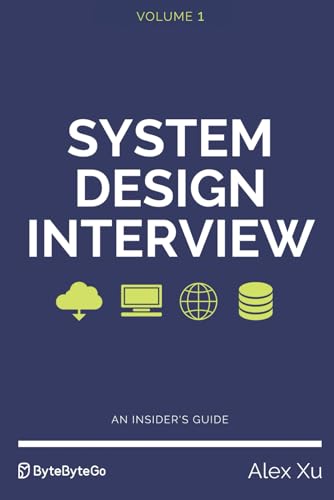
The system design interview is the round engineers fear most: forty five minutes, a whiteboard and a prompt like "design YouTube." Alex Xu's System Design Interview became the standard answer to that fear. Self-published in 2020, it grew into one of the best selling tech books on Amazon, spawned the ByteByteGo newsletter empire and turned its diagram style into the visual language half the industry now uses to talk about architecture.
What it's about
Xu opens with a simple four step framework: establish scope and requirements, sketch a high level design, deep dive where the interviewer steers you, then wrap up with tradeoffs and improvements. The rest of the book is that framework applied, chapter by chapter, to the classic prompts. Design a rate limiter. Design a key value store. A URL shortener, a news feed, a chat system, autocomplete, YouTube, Google Drive. Each walkthrough starts from naive and scales up, introducing consistent hashing, replication, caching layers, message queues and the back of envelope math for judging whether a design survives real traffic.
The teaching style is the selling point. Nearly every page has a diagram, prose stays minimal and each chapter reads like sitting beside a calm senior engineer who has seen this exact question a hundred times.
Why everyone's talking about it
Tech hiring never stopped being brutal and this book rides every wave of it. It sits permanently near the top of Amazon's software category, gets name checked in nearly every "how I got my FAANG offer" post and its sequel plus the ByteByteGo course built one of the most successful creator businesses in engineering education. Even engineers who are not interviewing keep it around, because the case chapters double as a compact catalog of architecture patterns.
The verdict, for now
Be clear about what this is: interview preparation, not systems engineering. The designs are simplified on purpose and anyone who has run these systems in production will find plenty to argue with, which is partly the point; arguing is the skill being trained. Pair it with Kleppmann for the underlying truth. But judged as what it sets out to be, a confidence machine for a high stakes ritual, it is easily the best of its kind.
Read it if you loved
Ready to read System Design Interview?
Get it on Amazon →