Michael Easter opens with an uncomfortable statistic: the average American now spends about 95 percent of their life indoors, climate-controlled, well-fed, never bored, never truly challenged. The Comfort Crisis argues that this unprecedented ease is quietly making us anxious, unhealthy, unfulfilled. His prescription is not another productivity hack. It is a month in the Alaskan Arctic with a bow, a heavy pack, no cell signal.
What it's about
Easter, a longtime health journalist, structures the book around a 33-day backcountry caribou hunt in the Arctic. The expedition becomes his frame for a bigger idea borrowed from Japanese tradition: the misogi, a once-a-year challenge so difficult you have a real chance of failing. Between scenes of hauling meat across tundra, he detours into research on boredom, hunger, silence, carrying heavy loads, time in nature, even the Bhutanese practice of contemplating death daily. Each chapter pairs the adventure narrative with interviews and studies suggesting that the discomforts our ancestors couldn't avoid were doing quiet work for our bodies and minds.
The book's most durable export is probably rucking, the practice of walking with a weighted pack, which Easter helped push from military circles into mainstream fitness. But the deeper argument is psychological: comfort is a moving baseline. The more we get, the more we need, which he ties to the concept of prevalence-induced concept change, our tendency to redefine problems ever downward as real ones disappear.
Why everyone's talking about it
Published in 2021, the book found a massive second life through the podcast circuit; Joe Rogan championed it repeatedly, wellness communities adopted the misogi as an annual ritual. It landed at the exact cultural moment when lockdown softness, screen fatigue, comfort eating were on everyone's mind. Easter's follow-up, Scarcity Brain, only widened the audience. Few recent nonfiction titles have converted so many readers into people who voluntarily carry sandbags up hills.
The verdict, for now
The Comfort Crisis earns its reputation as a genuinely motivating read; the Arctic narrative gives the science a spine most wellness books lack. Fair warning, though: the evolutionary arguments sometimes stretch thinner than the confident prose suggests. "We evolved for hardship" explains almost anything if you let it, some cited studies are preliminary at best. There is also an unexamined privilege in treating discomfort as a hobby; billions of people would happily trade for our problem. Read it as a provocation rather than a program. On those terms it delivers something rare: a book that actually gets people off the couch.
Read it if you loved
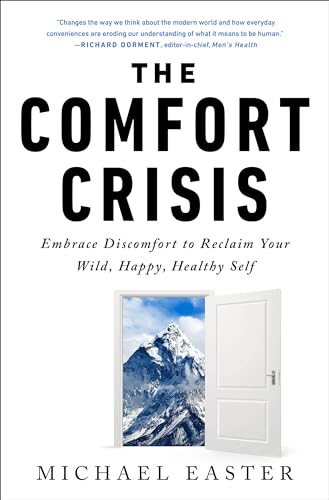
Ready to read The Comfort Crisis?
Get it on Amazon →