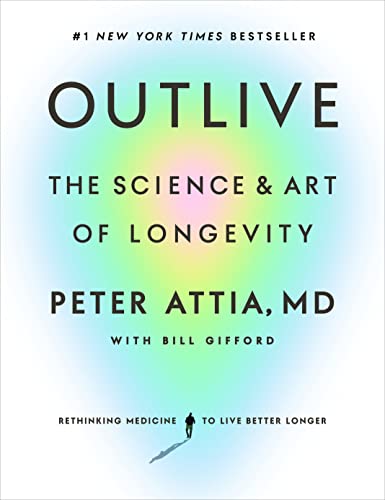
Most longevity books promise a hack: a supplement, a fasting window, a morning routine. Outlive is the rare one that tells you the work will take decades. Peter Attia, a physician who trained at Stanford and Johns Hopkins, argues that modern medicine is superb at rescuing people from acute crises yet strangely passive about the slow diseases that actually kill most of us.
What it's about
Attia's central idea is a shift from what he calls Medicine 2.0, which waits for disease to appear before treating it, to Medicine 3.0, which intervenes decades earlier. The targets are the four chronic killers he labels the Four Horsemen: heart disease, cancer, neurodegenerative disease plus metabolic dysfunction culminating in type 2 diabetes. Because these conditions build silently over thirty or forty years, he argues, prevention has to start in your thirties, not your seventies.
The second half turns tactical. Attia ranks exercise as the most powerful longevity intervention we have, with particular attention to zone 2 cardio, VO2 max work and strength training. He introduces the Centenarian Decathlon, a list of physical tasks you would want to perform in your final decade (lifting a grandchild, climbing stairs, getting up off the floor) then trains backward from it. Chapters on nutrition, sleep and emotional health round out the framework, the last drawn from his own struggles with anger and self-worth.
Why everyone's talking about it
Published in 2023 with co-writer Bill Gifford, Outlive became a runaway bestseller; it sat on the New York Times list for months and turned "healthspan" into dinner-party vocabulary. Attia's podcast The Drive had already built him a devoted audience, but the book pushed his ideas into the mainstream. Terms like zone 2, grip strength and VO2 max now circulate in gyms and group chats largely because of this book.
The verdict, for now
Outlive earns its reputation as the most serious popular book on longevity precisely because it resists easy answers. It has real limitations, though. Attia's protocol assumes resources most readers lack: extensive bloodwork, DEXA scans, continuous glucose monitors, many hours of weekly training. Some recommendations also run ahead of the evidence, a point critics have raised about his enthusiasm for aggressive early screening. The nutrition chapter is deliberately noncommittal, which is honest but unsatisfying if you came for meal plans. Read it for the framework rather than a prescription. The core argument, that you should train today for the person you want to be at eighty, holds up regardless of how much of the protocol you adopt.
Read it if you loved
Ready to read Outlive?
Get it on Amazon →